Showing posts with label art. Show all posts

Friday, 3 August 2018

Tracking the Tube: Jubilee Line 03: Neasden to Green Park


Weather: Blooming Hot!
Distance Walked: 17.7 km
Distance By Tube: 10.2 km
Stations Visited: 11
Fantastic Place: Grunwick Mural @ Dollis Hill Station


It's just about a year since I walked the previous leg of the Jubilee Line - as I mentioned before I now work five, sometimes six days a week so the frequency that I can walk for pleasure has gone down. The brightest amongst you will have noticed that this leg is walked the wrong way - I have been walking east to west but this one goes from west to east. Two reasons for this - I didn't thing Neasden was going to be a pleasant place to stop for lunch and I needed to pick up some emergency supplies from Games Workshop in town so those two factors suggested a switch-a-roonie of the route. I won't let it happen again!

 
The Stations en-route
So on one of the hottest days of one of the hottest days on record I set off to sunny Neasden. The start of the walk took me through some rather grimy industrial areas including several skip hire companies - they have to be based somewhere I suppose and the proximity to the North Circular is a probable draw. While I worked on the LUL IT systems back around the millennium I paid a visit to the Neasden depot and was shown the only level crossing on the London Underground network. Ok, it's in the depot but it is a proper level crossing with lights and barriers.

All I knew about Dollis Hill was that one of my favourite guitarists Steve Hackett and his brother John lived there for a time, it's the sort of place you flash through on the tube without looking up. Having now walked through it my opinion has been revised, it is in fact, quite attractive with the large Gladstone Park on the north side of the railway a key feature.

Just by the station is a large mural commemorating the Grunwick Strike which by one of those strange coincidences took place in 1976 the famous long hot summer of my childhood against which all other summers have been judged. Along with the Miners' strike which took place during my time studying geology in Cardiff (went down a coal mine the week before the strike and this made me realise what a hot, hard and horrendous job the miners did), has coloured my political thinking ever since.

The majority of the area is nice Edwardian terraces and semi-detached houses along quiet leafy streets seemingly populated solely by cats! Between Dollis Hill and Willesden Green, I saw at least four cats sunning themselves in gardens, on walls and even in the middle of the road. 

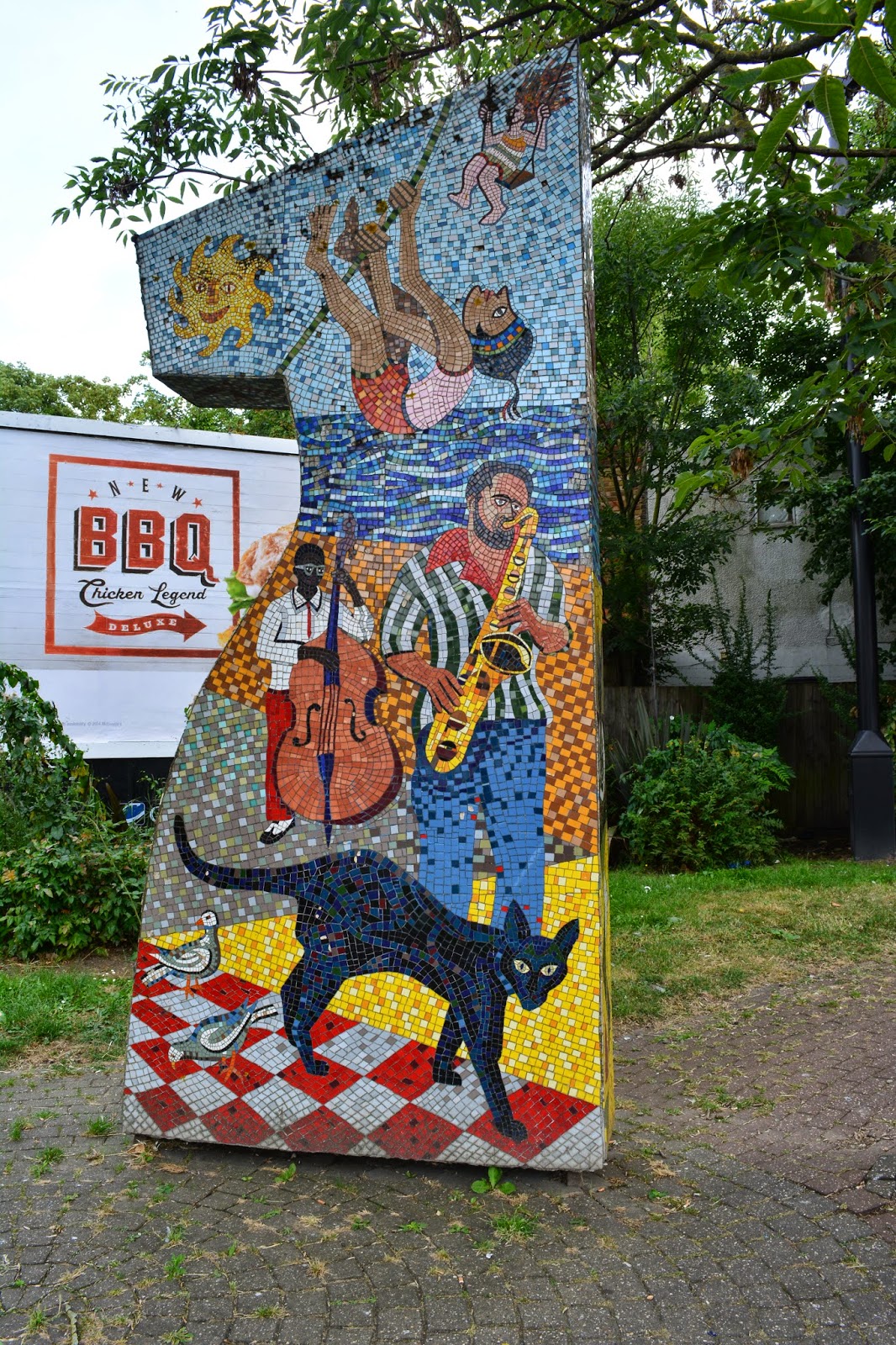
I had confused Willesden Green with the grotty Willesden Junction (of many a delayed journey into work fame) and was therefore pleasantly surprised again by the surroundings of this majestic station. Opposite the station was an appropriately cat themed mural.

More pleasant suburban streets stretched out between Willesden Green and Kilburn - I suppose I shouldn't be surprised as we aren't that far from Hampstead - in fact, some of the older tiled street signs still said Hampstead rather than Camden on them.
View down the tracks towards Kilburn

Bowls Club Clubhouse
The busy interchange at Kilburn stands on the A5 which is named here Shoot-Up Hill and has multiple viaducts casting welcome shadows over the station opposite which were more murals.
The next stretch along the former Roman road which is now the A5 was hot and busy even though it was only just 10am so turning off and walking through the leafy Kilburn Grange Park was a nice relief. Another cat, this one in a shady catbox on the steps outside its house, was enjoying a doze in the sun before a stretch of uphill walking brought me to West Hampstead station near which is Lillian Baylis house, the rehearsal rooms for the English National Opera.
Nice Orange Saab - Classic

Hampstead Street Art? Owl or Ironing Board?

The Swiss Cottage
The next stretch felt familiar from many days of playing D&D with my Hampstead pals and a stretch of the busy Finchley Road down to the odd Swiss Cottage. Stuck in the middle of a traffic island between the A41 and the Finchley Road it looks a bit lost and difficult to photograph.

The next stretch continued southwards through ever nicer streets towards St John's Wood which has the most totally tropical tube station I've ever seen.

The Famous Abbey Road Zebra Crossing
Continuing westward for s a stretch I saw large crowds standing by a zebra crossing and was momentarily puzzled before recognising this as the Abbey Road crossing made famous by the 1960's beat combo known as The Beatles. I'm not a fan myself but I know my sisters are (I think they may have seen them once but I am sure they will correct me if I'm wrong). If I had to drive through here on a regular basis I would get very peed off as there are always people crossing, pausing for their photo (with the photographer often standing in the middle of the road), then crossing back again! The Abbey Road studios are just a little way along the road surrounded by a white wall covered in graffiti.

 Continuing south I passed Lord's cricket ground - it is surprisingly understated combared to the red brick edifice at the Kennington Oval. The high wall prevents any glimpse of the hallowed turf (apart from a glimpse through the turnstiles) and the only hint that something lurks beyond is the modern media center that looms over the wall like one of the Martian space craft in War of the Worlds or The Tripods.

More crowds surround the entrance to the Sherlock Holmes museum on Baker Street - the queues stretch back from the museum all the way to the tube station, many of them tourists who are probably disapointed not to experience a true pea-souper or a trip in a Hansom cab.

After a lunch stop in the busy shopping streets south of the Maylebone road I braved the heaving hordes of Oxford street for a quick glimpse of Bond Street station before detouring to the Warhammer shop on Tottenham Court Road before heading south and west once more to reach the end of this leg of my Jubilee walk at Green Park. Hopefully it won't be a yeat before I complete this line - only a few stations to go now from Neasden to Stanmore.

Bubbles at Fortnum and Masons


Tuesday, 1 August 2017

Tracking the Tube: Jubilee Line 02: Canary Wharf to Green Park


Weather: Warm and pleasant
Distance Walked: 22.5km
Distance By Tube:10.77km
Stations Visited: 9
Fantastic Place: St James' Park


It's been a while since I last did a Tube Walk. Since the last one I've found a new job - one that isn't so desk bound as the last. I now spend a lot of time walking from one end of the site to the other, visiting users and often crawling under their desks. The walk to and from work is also far more pleasant, being through very pretty suburban streets of Kew in the leafy borough of Richmond just south of the River Thames. I now do upwards of 10000 steps everyday sometimes reaching the dizzy heights of 16000. On the down side I now work five days a week instead of four which means that the Tracking the Tube project will take a lot longer to complete.

The nine stations on the walk today
Starting back at Canary Wharf I was struck again how much had changed since I worked here back in the last Millennium! In fact there was even change since the last time I walked here a year ago. I walked a slightly different route back through docklands as I headed south, following the west side of Millwall Inner Dock and the east side of Millwall Outer Dock.

These are now surrounded by offices and housing rather than the warehouses and industry that would have been there when the docks were a thriving centre of shipping and trade. Even so there were a large number of narrow boats and other house boats moored in the basins, many brightened up with flowers and vegetables growing in any available space.

On the open water of the outer dock there were small sailing dinghies and wind-surfers making the most of the sun and brisk wind that gets funnelled through the canyons formed by the tall buildings. Because of the mix of housing and office space docklands is still busy and bustling on a Saturday unlike the areas around Chancery Lane and the old financial centre of London which can resemble the setting of a post-apocalyptic wasteland at the weekend.

A little further on near Mudchute (possibly one of the least glamorous names on the DLR network)  there was a small housing development, probably late eighties early nineties) built around a set of private moorings. None were in use by boats, however there was a pair of Great Crested Grebe nesting there and on a semi submerged pontoon a family of Canada Geese). Lots of other ducks and sea birds had made their home in this peaceful little haven - which was nice.

Walking under the Thames via the foot tunnel I headed west past the Cutty Sark on the Thames Path soon coming to a very odd statue of Peter the Great. The proportions are really very odd but it makes a striking addition to an area dominated by drab modern apartments.

Continuing along the Thames path which occasionally swings some way inland I passed through a park with a old, gnarled mulberry tree. I'd love to have one of these in my garden at some point. The fruit wasn't ripe but there was a lot on the tree. I wonder if anyone comes to pick it or if it just gets eaten by birds.

Heading inland at a large marina filled with canal boats and sailing craft I left the Thames behind and headed through Rotherhithe to Canada Water station. This station, like most on the relatively new extension, is a striking modern building. This one resembles one of the vehicles that the Sand People in Star Wars travelled around in collecting scrap and selling faulty droids to moisture farmers!

Passing through Southwark Park I soon came to Bermondsey station which was quite restrained in design on a long road lined with shops and cafés. Passing under the bridge carrying the trains out of London Bridge station the smell of a local craft brewery filled the air bringing back memories of living in Cardiff and the Brains brewery that filled the air with malty goodness most days!

This part of London on the run up to London Bridge station has a large number of very nice streets lined with Georgian and Victorian terraces and old schools turned into flats. Very attractive, if small, front gardens added to the ambience. The nearer I got to the station the more hip the area got with lots of small coffee shops, including one called "Fuckoffee." The National Fasion and Textile Museum is here as are a number of small galleries and craft workshops. London Bridge station is rather large and sprawling but is dominated by the glass and steel of Isengard the Shard that towers over it.

After a quick stop at Hotel Chocolat for some 'emergency supplies my path led back to the Thames and a visit to one of my old workplaces on the South Bank opposite St Paul's. A Quick stop for lunch at Eat reinvigorated me for the second half of the walk, briefly along the Thames before turning off by the reconstructed Globe theatre (well worth going to see a performance there) and heading south to Southwark station. The route I took went behind the Tate Modern gallery at Bankside. This opened soon after Liz and I moved to London and was part of the flowering of art and culture in London around the Millennium. London has always had great art spaces but it just seems to have got better and better. The new gallery space at the Tate is housed in a stunning building which sits well beside the old power station.

The area between Southwark, Waterloo and Westminster stations is horrendously busy especially on a sunny Saturday during the summer holidays. It makes walking at a normal pace almost impossible. The area between the London Eye and the Houses of Parliament is particularly bad with tourists sitting on the steps and waving their selfie-sticks around. It was quite a relief therefore to break out of the congestion and walk through the, still busy but more peaceful surroundings, of St James' Park. I don't think I've even spent much time in this large green lung in the centre of London which runs from the political heart of London right up to the gates of Buckingham Palace. At the heart of the park is a long lake surrounded by flower beds and despite the large number of visitors it still has a peaceful air. The lake has lots of wildfowl (a theme of today!) including some pelicans which you are warned not to feed. This may be why!

After waving at the queen I turned north through another of London's large parks, Green Park to the station of the same name. As a geologist I like what the designers have done with the walls of this station. They have used fossiliferous limestone in which you can see the calcified remains of ammonites and other extinct see creatures. The designers have then carved larger stylised versions in the walls.

The last stretch from Green Park to Bond Street station is one that I've walked many, many times with my wife when we visit the Royal Academy of Arts and you pass many swanky shops and galleries before arriving in the throbbing heart of Oxford Street with all it's department stores and other shops.

That was enough for today and I could feel that I hadn't done a long walk for a while in the backs of my legs. It was however one of my favourite tube walks of the project so far. It was a transect through time and space showing the various parts of London. It started in the new heart of financial London, moves through the old dockland and commercial centre, through art and culture, political London, Royal London and finally shopping London. All of these areas have their own flavour and architecture and the route is well worth a walk if you have half a day to spare.

New tower looms over a floating restaurant

Interesting sculpture near Canary Wharf station

Standing tall
Parts look more like Amsterdam than London!
Great Crested Grebe at Mudchute

Philip the Great and Small Friend


Storm Clouds over the City

The Shard

The new galleries at Tate Modern


Friday, 1 August 2014

Tracking The Tube: Bakerloo Line 01: Harrow & Wealdstone to Kilburn Park


Weather: Very sunny, warm and humid
Distance Walked: 21.2 km
Distance By Tube: 13.2 km
Stations Visited: 10
Fantastic Place: Mentmore Close


This was not the most inspiring of lines to walk. Most of the northern stretch of the line lies within 1930s suburbia, numerous terraces and associated light industrial units and the North Circular. Still there must be some highlights. In desperation I turned back to Mark Mason's "Walk the Lines" the inspiration behind this project. I spotted that not far 'off the cotton' was the scene of one of my favourite comedy moments so noting that on my route plan I shrugged on my rucksack and set off.


Most of the northern part of the line is shared with mainline services hence the stations are large and lack the traditional Underground architectural aesthetic (ooo get him!). It is not  until I reached Kilburn Park at the end of this leg that I got to see a 'traditional' station building.

Harrow & Wealdstone station has an interesting mural produced by local school children marking the Millennium and all the famous events that have happened in the area. This included a record of the major train collision that happened in 1952 which led to a raft of improvements in rail safety. On the subject of the railways it is worth reading Christian Wolmar's books in particular "Fire & Steam" and "The Subterranean Railway". Both are written in an entertaining style and bring across the chaos and corruption of the early years of the industry.
Walking through light industrial units beside a busy road towards the pleasent open spaces of Kenton Recreation Ground I passed a gloriously colourful Hindu wedding party that lit up the grey drabness of area. The car parks were full to bursting and lots of people were sitting eating rather tasty looking food.

Passing Kenton Station I diverted from the direct route to visit Mentmore Close site of this classic comedy moment.


It would be easier now with the dropped kerb but he'd need to watch out for the bollards.

Should have a blue plaque if you ask me!

The whole estate, in particular the nearby Northwick Circle is an attractive area. This is another of those places I'd never been to nor did I realise that Kenton and Northwick Park stations are so close together, no more than a 5 minute walk yet by tube it would take the best part of an hour and a change of trains at Baker Street!

My route then took me under the tracks at South Kenton where I had a case of deja vu  - this is also the route of the Capital Ring. On to North Wembley through more nondescript suburbia and on to Wembley Central. I'll associate much of this part of the walk with the smell of bins, Friday being collection day, and the large wheelie bins parked on the pavement and in the small front yards were warming up nicely giving off that fragrant aroma you get with heated seepage at their bottom. These seepage has now been given the name farage in one of the 'urban dictionaries.'

Wembley Central has been undergoing building works for some time so I've no idea what the station used to look like hence the rather odd photo! Onwards we travel between high metal fences beside a playing field with Wembley Stadium in the distance.


Stonebridge Park is one of those places I've driven past too many times to mention as it lies on the North Circular road. As a pedestrian it is a maze of road crossings, semi-derelict office blocks and numerous railway lines. The station is up a cul-de-sac and is another of the brick shed style of buildings I've seen before on this leg, Harlesden next up is another. Leading up to Stonebridge Park you pass through the area known as Tokyngton "the farm of the sons of Toca" - not much farmland around now though.

I considered walking along the Grand Union Canal between Stonebridge Park and Harlesden but this section runs through more industrial buildings than you can shake a stick at and may not have been any more interesting than the more direct route.

After Harlesden I came across some attractive mosaics at the junction of Acton Lane and Minet Avenue.


Willesden Junction is a complicated station with lines and platforms running in all directions (which is why it is called a junction I suppose). Took me a while to work out which way to go through the station to end up at the correct exit onto the Harrow Road towards Kensal Green. Willesden Junction is the first of four completely different designs of station. In this case quite modern ticket office on a higher level above the more traditional style platforms. Kensal Green is like a wooden chalet, Queens Park a strange metal box and finally Kilburn Park the first of the traditional blood red tile constructions typical of the main part of the old Underground network.

The walk from Kensal Green to Kilburn Park started to lead into more 'upmarket' properties with gastropubs, the odd art gallery and many eateries. Portuguese restaurants were fairly common, I normally associate Vauxhall where I work with Portuguese shops and cafes but it appears there are at least two little Lisbons in London.  Just before Queen's Park, the area named for Queen Victoria, there is a very pleasant park with an active local preservation group where the QPR football club started.


Next leg will hopefully be more interesting as I head through the heart of the city and out the other side.


Tuesday, 11 June 2013

Strolls in Sussex: Two Rings to Rule them All

Weather: Warm and Sunny

This was a simple but very pleasant walk between two Iron Age hill forts in West Sussex. What made it extra special was that I could do it with my wife and being that it was pretty much on the level on wide tracks we could do it side by side discussing what we saw on the way. On hillier routes Liz normally complains that all she sees is a rather large backside...

Anyway... we started the walk by walking around the ramparts of Cissbury Ring, the largest hill fort in Sussex which dates back some 5000 years. From the ramparts you get fantastic views out to the coast and across the Sussex Downs. It was lambing season and everywhere you looked the lambs were gambling and bleating in a very cute fashion. It also gave me an idea for a game to play on walks - lamb bingo. Each lamb tends to have a number on it to match it with its mother so it would be easy to carry a bingo card with you and when you see a lamb or ewe with the appropriate number you can tick it off on your card.

I am not a number, I am a free lamb

After walking around the ramparts (a group was actually jogging round which I felt was a bit extreme) you return past the small car park (I would like to point out that the track out to the ring could have been better signed we kept getting lost in the little village before finding the correct track) and along a wide chalk track with Chanctonbury Ring in the distance.
Chanctonbury Ring by Jeremy Blighton
Like the Long Man at Wilmington, we were inspired to do this walk by our shared love of the ancient landscape and our etching by Jeremy Blighton.

The walk is easy as all you need to do is follow the wide track, keeping the tree capped hill of Chanctonbury Ring in view.

Eventually you reach a signpost marking the junction with the South Downs way - something we seemed to cross with somewhat scary frequency on many of the main roads we travelled on our holiday. If I was going to walk the South Downs way I would be concerned at the number of times I had to cross bury dual carriageways - especially if it was towards the end of a long hot day. I remember the same thing happening on the London LOOP, after you've walked twelve miles in the rain or sun there is very little left in the tank for rapid acceleration!

Chanctonbury Ring is smaller and covered with a cap of trees giving it a much more mysterious feel to Cissbury Ring and proved to be a more than acceptable picnic stop before we returned along the same track, this time with a view of Cissbury Ring to guide us back to the car all the while red kites circled around on the strong thermals.