Sunday, 12 February 2012

London Loop: Section 8: Donkey Wood to Uxbridge Lock

Kingfisher on the River Colne
I wonder if my rope's still hanging from the tree
By the standing pool where you drank me
And filled me full of thirsty love
And the memory of water?

I wonder if a king still fishes there
His back towards the burned-out air
His laughing catches singing loud
The memory of water

- Marillion, Memory of Water

I don't think I have every been so cold as this, even being snowed in on a concert tour of North Germany where the River Wesser froze over and we had snow drifts a dozen feet thick piled up against the youth hostel walls can compare. I must be getting soft in my old age. This walk starts, like the last one finished, with a dreary walk alongside the A30 with jumbo jets and huge A380's blasting off from Heathrow over my head but soon you turn off and join the river Crane again. Just before that however, parked next to one of the giant British Airways' hangers was a Concord. Still as brilliantly different as ever but looking rather sad and lonely. I remember having to pause my lessons at about 11am each day as Concorde took off from Heathrow not far from the school I taught at.

The snow that fell earlier in the week was still lying on the ground and any muddy patches were frozen into rock hard ridges and my mood was lifted by spotting a fox that paused to study me ahead on the path and a falcon perched on a broken branch above my head. I wonder if they were both hunting the rabbits I saw a few moments later bounding across the path to find cover in the brambles? I love the wildlife I see on the walk and this gave me hope that this was going to be a good leg, despite the cold!

Despite the early part of the walk following the A30, crossing the A4 and diving under the M4 the walk felt very rural as it tracked the meandering River Crane with its frozen oxbow lakes and snow covered banks. In places the snow was 5-8cm deep and made walking difficult as you crunched through the icy crust into the powder below. Leaves were covered in a rind of frost and Crane Meadows between the A4 and M4 were particularly pretty with their coating of snow.

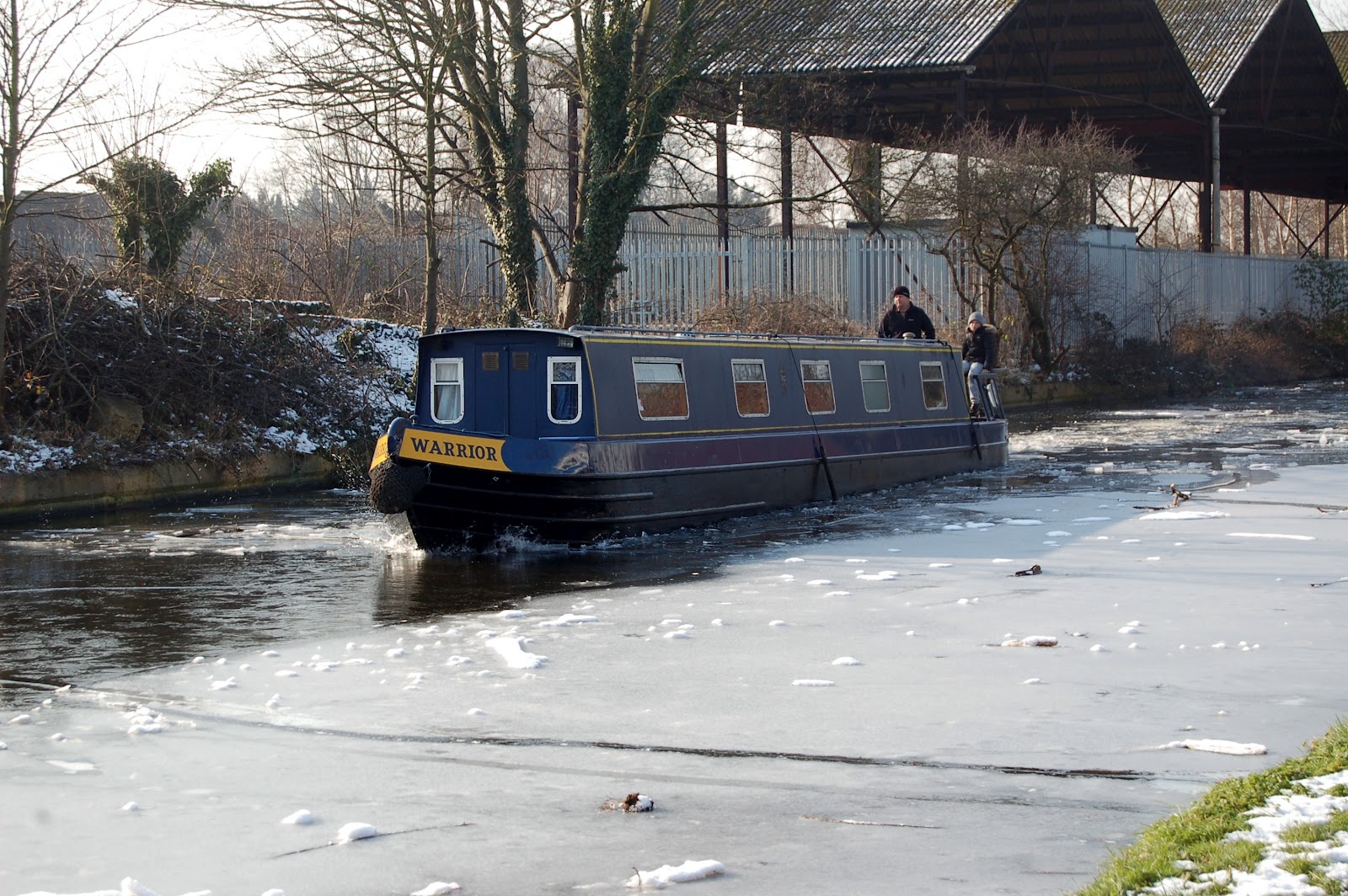
After the M4 the walk joins the Grand Union Canal as it winds its way from London to Birmingham. In parts the water had frozen over with only the odd gap under bridges and where rivers and surface water drains pour warmer water into it. It was quite amusing to watch coots come flying in, land on the ice and skid, sometimes backwards, for some distance before colliding with the bank or one of their fellow canal dwellers. Most boats were moored up for the winter, their owners working on maintaining the boats for the summer season. One or two were working their way through the ice though, dramatic cracking sounds as the metal hulls forced their way through the ice.

The path swings away from the canal for a time through Stockley Park, a modern science park. Very icy paths through here were snow has melted and refrozen on the tarmac paths. Back to the canal the path goes close to West Drayton, where I taught for five years, before leaving the main Grand Union for a short stretch along the Slough branch of the same canal. At the junction is a huge marine crammed with canal boats of all colours and sizes and a haze hung over it from the stoves that were running on some of the boats.

The path then joins the River Colne as it runs through an area of former brickworks which have been flooded. The area was famous for its bricks and the canal was used to ship them into London in their millions. Passing through a wooded area I caught a glimpse of copper and turquoise as a kingfisher exploded from the river and landed on a branch with a small silver fish in its beak. I started to creep closer but before I could get very far a car door slammed and it was off. I saw it again a couple of hundred of yards later but again too far away to get a decent photo. This probably was the best moment of any of the walks I've been on, you don't get to see a kingfisher everyday in London!

This sight kept me going through a slightly grotty leg where the path runs between tangled branches and a high metal fence before a short road stretch leads you back to the canal and the final walk towards Uxbridge. By now I was feeling very cold where the bustling high street and tube station were very very welcome!

Saturday, 7 January 2012

London Loop: Section 7: Kingston Bridge to Donkey Wood

Early December and still the weather does not feel like winter. Clear blue skies to start with but there had been some rain over the past few days but compared to 2010 when the walk would have been several inches deep in snow things were a lot better!

The walk started off well with a stroll through Kingston and I managed to avoid stumbling into the large John Lewis store instead crossing the Thames by the old bridge and then by an easily missed sign into Bushy Park. This part of the walk was probably one of the most interesting and attractive of the LOOP so far. Attractive parkland, nice trees which had lost their leaves but kept their striking skeletal forms and some lakes with rafts of birds.
Swans in Bushy Park


Of course while doing this I failed to 'live in the now' and tripped over a hummock and did a rather impressive forward roll/somersault which if it had been caught on camera would have earned me a place as a stuntman!

Spent a bit of time in the parkland watching some Long Tailed tits in the trees around the small stream and artificial lakes and chatted with a photographer who was taking photos of the birds. The usual comments of birdwatchers; the decline of greenfinches the rise of the Ring Necked Parakeets and the best food to put in the garden to attract birds to the table.

The next section of the walk was the best and most exciting. Having read in the guide that deer can be seen in the open parkland I was expecting to see a few in the distance like I saw in Richmond but I was wrong. Instead there was a group of at least a dozen straddling the path, some with full on antlers grazing and in some cases butting antlers with each other. I was able to spend some time watching and photographing them without them taking any notice of me, a real joy.

Deer in Bushy Park
After a section of road walking the path joins the River Crane. Here you pass some interesting industrial archaeology - the remains of gunpowder mills. I hadn't realised that this part of greater London had been famous for the production of gunpowder. The remains of several mills can be seen on this leg and the previous one surrounded by high earth banks to protect the surrounding mills and buildings from the force of any explosions. One of the mills now houses a interpretive centre for a bird reserve that occupies an island in the middle of the river, it was closed at the time of my visit but might be worth a return visit later. The path here was muddy, very muddy, with thick black mud rich with rotting leaves. A great smell but quite awkward to walk through and this got worse as you progress along the rest of this section.

With clouds building and time pressing, I should have spent so long with the birds and the beasts earlier in the walk, there follows a drab road section and then a wild, blowy walk across Hounslow Heath, a surprisingly wild place in the heart of this part of London. The next section returns to the Crane and includes several difficult sections. Difficult navigation and difficult walking along narrow paths, some no more than a foot or three wide between a chain link fence and the steep side of the fast running river. With the sloppy black mud of the path added to these this section was quite awkward and not particularly interesting. A section of slimy a and springy boardwalk was a slight improvement before possibly the worst section of the LOOP so far. A half hour slog beside the very bust A30 all the way to Hatton Cross tube station. This was made worse by the long waits at the numerous crossings you have to use to get across the road to the station itself.

A shame that he walk has to end on this grimy, grim, rubbishy, noisy, smelly, boring note after it had started on such a high. Add to this that the next leg will start with another joyless yomp beside the A30 to get back to the LOOP doesn't make me look forward to January's walk with any great joy.

London Loop: Section 6: Banstead Downs to Kingston Bridge

Getting to and from Banstead Downs is a bit of a pain as trains only go to this remote stop once every hour so I had a 45 minute wait on a cold Clapham Junction platform in November waiting for the train. The weather was grey and overcast with a hint of rain in the air. This didn't put me in the best frame of mind for the walk and this mood wasn't improved by the attitude of the golfers on the golf course just after the start. Their arrogance and rudeness to me and to a pair of other walkers was not a good advertisement for their pastime. It was nice however to meet and chat with a pair of fellow walkers who were also doing the Loop. It was helpful as well as navigating across the golf course was difficult and six pairs of eyes were better than two!

After the golf course the route goes through a long urban section with little to recommend it before going under a railway bridge onto open scrub-land. An interesting section this as it was going to be built upon and the concrete bases of access roads were built but the housing estate never was. These run through a stand of trees giving an eerie impression of a ghost town. Looking west along the tracks the sun came out for a moment and standing in the dappled shade looking back at me was a fox and its cubs. It stared at me for a few moments before walking across the concrete tracks and into the woods.

The path then runs along side the parkland of Nonsuch Park and the ruins of the Tudor Nonsuch Palace. Time for another moan here - sorry if I'm coming across as a grumpy old man. Dog owners, thank you for bagging up your dog poo but nobody thinks that they make attractive tree decorations. Take it home or bin it, don't hang it from the bushes of chuck it up into the branches of the trees. Thank you.

After the minimal ruins of the palace you pass through Ewell which looked very attractive but with the shorter hours of daylight I was in a hurry to get on. This meant that I didn't stop to explore the museum in Bourne Hall Park. The path then goes under a very low railway bridge on a platform on top of the river. This pushes a lot of irrational fear buttons for me - dark water, constricted spaces and heights. Needless to say I got through as fast as possible!

Most of the rest of the walk is alongside the River Hogsmill which meanders its way through scrubby woodland and open (and muddy) grass for several miles. This is a peaceful section but with the grey overcast skies it was a little sameish with no bit views to excite or enliven the walk. Things didn't get any better later on as the next section runs past light industrial units and a sewage works before emerging at last on the Thames at Kingston. This last five minutes was possibly the best bit of the walk with the views along the Thames including Kingston Bridge being very attractive. Then up through the shops to a proper station with trains running every few minutes into central London and somewhere to buy a snack before heading home!

All in all probably the least inspiring leg of the walk so far to be honest.

Monday, 14 November 2011

London Loop: Section 5: Hamsey Green to Banstead Downs

A surprisingly warm and sunny October day - weather has been better in our Autumn than we had in the Summer. Still as I had made an early start there was still frost and a heavy bejewelling of dew in some of the pretty wooded hollows near the start of the walk.
The walk starts from Hamsey Green, a bus ride away from the centre of Croydon, the bus goes past some of the buildings burnt out in the recent riots, a sombre start to the day's walking. Climbing up onto Kenley Common I looked back to be surprised to see huge chalk cliffs the remains I assume of quarry workings.

Chalk Cliffs


After a short section of suburban walking the views open up and you find yourself on an old coaching track known as Riddlesown Road. It is always a bit special when you encounter an old track like this or a section of Roman Road when out walking, for me this is more exciting than finding a building and it is easy to imagine other people walking the same route as you several hundreds of years before.
Once through Old Couldson you enter possibly the most stunning part of the LOOP so far. Wide open views of chalk downland. Coming from Hampshire with its similar geology and terrain I felt very much at home and nostalgic. Other than the odd dog walker and a few people on horseback I had the landscape to myself and with clear blue skies and warm sunshine above was very happy.

Happy Valley

More ancient landscape follows as the walk continues along Farthing Downs with a Saxon burial ground just off the track to the right and stunning views of the city as you reach the end of the ridge.
Back to earth after leaving the downs with a dull trudge uphill through the urban sprawl of Coulsdon (sorry any readers from that suburb). Once back into the countryside you find yourself in rather depressing open space with views to Wembley in the distance including the arch of Wembley Stadium. Mood was lightened by the scent of lavender which appeared at first to be coming from nowhere but it turned out to be a lavender farm. The lavender had been harvested but the scent of the herbs still hung in the air. Across the road the route goes through Oaks Farm (the original owners of which gave their name to the famous horse race) where there is a craft centre but more importantly a cafe which serves good food, just what the doctor ordered!
 The path then follows a slightly sunken way past stables and a prison before emerging onto more downland. The path then crosses a VERY busy dual carrigeway with four lanes of fast moving traffic. Getting across was a bit of a challenge with no lights, subway or zebra crossing and with legs a bit leaden after 10 miles of walking. Eventually there was a gap and I managed to get across. Then followed a rather comic period where I managed to get lost on a golf course. I waited or a golfer to make a real pig's ear of getting out of a bunker (first shot went 6 inches the next sailed over the green ad into the shrubs on the other side. Once he stopped swearing he gave me directions to the station at Banstead.
After a god start and a fantastic middle the walk went down hill a bit at the end with too much urban walking and too many busy roads.

London Loop: Section 4: West Wickham Common to Hamsey Green

Realise I have been a little slack and have not written about these two walks yet even though I did them one and two months ago. Leg 4 from West Wickham Common to Hamsey Green starts with a long link section that goes up and down along  a fenced path. I remember this from the previous walk where I was pretty tired and this long and rather dull link at the and was the last thing I needed. More suburban street walking follows until you reach an old church with fine views over wooded countryside. The next section through sports fields leads to a steep climb up to and through woodland. All still in leaf at this point and including sweet and horse chestnuts, oaks, hazels and even an almond. Nut-tastic! As you emerge from the Theehalfpenny Wood you get a good view back to London including a glimpse of the Shard which is now almost complete. This building near London Bridge station has been one of the landmarks of the LOOP so far as for several legs London Bridge station has been my starting point.

The path then meanders through more meadows before climbing up to the viewpoint on Addington Hill. From here on a clear day you can get a fantastic panorama of the London skyline. Today was a bit overcast but the view was still pretty good. It would have been better if someone hadn't stolen all the brass identification plates so I could have known what I was looking at!

View from Addington Hill
I could identify the Shard, Docklands, Gherkin and a windmill in Shirley. Descending through a nice park you then emerge back into the suburbs and my first encounter with Croydon's tram system. Quite an extensive network and quite quiet so you may not notice them coming! More pleasant open space and woodland follows until you arrive at the small hamlet of Hamsey Green where I picked up a bus back to Croydon. Took a tram back to Wimbledon for a change of pace rather than a mainline train back to the city.


Sunday, 28 August 2011

Two Welsh Walks: 2 - A Circular Walk From Moelfre


This walk, about 4 or 5 miles, contains everything that is interesting about Anglesey. It starts with a stretch along the Anglesey coastal path heading north. It is best to avoid the car park by the harbour as it is: 1. Small. 2: Expensive: 3: Difficult to get out of as it is very busy! Unlike the walk from Cemaes Bay the path is wide and climbs and descents are gentle. The rocks are different as well, gently dipping beds of massively bedded limestone. It is also a coast of wrecks and signs of this are apparent in this part of the walk. At least two monuments to wrecks stand on the coast and there is a museum dedicated to the lifeboat and their crews just outside of Moelfre.

The path passes a small, low island covered with sea birds and leads eventually to the wide sandy Ligwy Bay. Despite it being the height of the school holidays the beach was not crowded and there was a welcome bothy selling ice-creams which made for a satisfying break before heading away from the coast and along a series of quiet inland lanes.

Along this stretch of the walk you see signs of human habitation from the eolithic to the Middle Ages. First you see the ruins of Chapel Hen, a chapel of ease. Most was built in the 12th century but extensions, including a 16th century burial vault (great for all you D&D enthusiasts out there). Now it is a roofless ruin but the setting is very striking.

From here you walk into the woods and find the ruins of a Romano-British settlement. The stone walls of two circular dwellings and several more rectangular buildings on a low hill surrounded by a wall built probably to keep animals in rather than invaders out. The larger rectangular buildings are thought to be workshops and barns, the circular buildings living quarters. A striking site and well worth a visit. From here the lane leads to third, final and by far the oldest site. A huge capstone set on a circle of smaller stones. The remains of twenty or more men, women and children have been excavated from here and dated to about 2500-3000BC.
From here the walk returned to Moelfre via field paths and some very steep stiles until the welcome site of Ann's Pantry hove into view where a much needed cup of coffee and a slice of cake set us up for the drive back to the cottage.

Two Welsh Walks: 1 - Cemaes Bay to Bull Bay


This walk is part of the Anglesey Coastal Path and as such is clearly signed. On top of that being a coastal path finding the route is dead easy: you just keep the sea on your left and you can't go wrong.
The walk starts in the tidy little village of Cemaes which has a lot of useful shops including a Post Office, vital when you are on holiday and needing to send post to relatives around the world. This is a linear walk, I was dropped off at the start and my wife drove to the Bull Bay Hotel where I would be picked up later (after an obligatory pint (for medicinal purposes only of course)).
Cemaes Bay itself is a striking example of Precambrian geology with folded and twisted rocks of great age. Part of a subduction zone (a destructive plate boundary where one plate is forced beneath another and destroyed, often forming a volcanic island arc in the process). As an ex-geologist this was a particularly interesting part of the walk for me. The path climbs steeply up beside the coast and for much of the route it is very narrow with little separation between the path and the sea some hundred or so feet below.

The route is about six or seven miles in length but it feels a lot longer as there are a number of steep climbs and descents most of the time with steep rough steps but sometimes not. After about the fourth of these climbs my lungs were burning and my head throbbing – walking the London Loop is one thing – tough coastal paths are something else!
There are many signs of industry round the walk, in particular the remains of a wharf and extensive buildings at Porth Wen.


These are the remains of a brickworks I learnt from the barmaid of the Bull Bay Hotel. From this point the path becomes more level and wide making the going easy and at last I was able to enjoy the views of the coast and the heather coated slopes inland. Keep your eyes pealed for wildlife; I think I saw a seal in one of the coves and porpoises are said to swim offshore. Birds are common too; I saw oyster catchers in Cemaes Bay and a kestrel perched on a fence post about twenty paces away from me at one point. I think he was waiting for me to keel over and flew away when he realised I was not going to be supper! There are plenty of viewpoints suitable for a packed lunch, in particular the Lookout Tower on Llanlleiana Head. The walk, though tough in places is well worth the effort and I felt that I had earned my pint at the end.